
Coke County Court Records After Arrest
The arrest-to-court pathway in Coke County has three layers. The sheriff or arresting agency keeps the arrest or incident record. The prosecutor decides what charges to file, reduce, amend, dismiss, or present to a grand jury. Once a case is filed, the court record belongs with the County/District Clerk and the court. That court record is the source for filed charges, case number, hearings, bond orders, warrants, dispositions, and later record-clearing filings.
A jail roster charge is not the same thing as a formal court charge. A receiving jail profile may show a booking charge and bond warning, while the Coke County court record shows the complaint, information, indictment, docket settings, and charge status after prosecution review. For custody and booking detail, use Coke County jail inmate records. For booking photos, use Coke County jail mugshots.
Coke County Court Records Search
The Coke County County/District Clerk is the key court-record office. The clerk page lists Carolla Orcutt at 13 East 7th Street, Robert Lee, TX 76945, phone 325-453-2631, fax 325-453-2157, and email carolla.orcutt@co.coke.tx.us. It also lists Chief Deputy County/District Clerk Cindy Sawyer. Office hours are Monday through Thursday 8 AM to 5 PM and Friday 8 AM to 1 PM, with a Thursday lunch period and election-related hour changes.
The clerk page links both a court calendar and judicial case search. It also notes accepted payment forms: check, credit card, money order, cashier's check, and exact cash because the office does not keep a cash drawer. That local note matters for in-person copies or record requests. The calendar is the public scheduling route, while the full iDocket judicial case search routes to sign-in or subscription access.
The Coke County County/District Clerk page shows the local court calendar and judicial case-search access points.
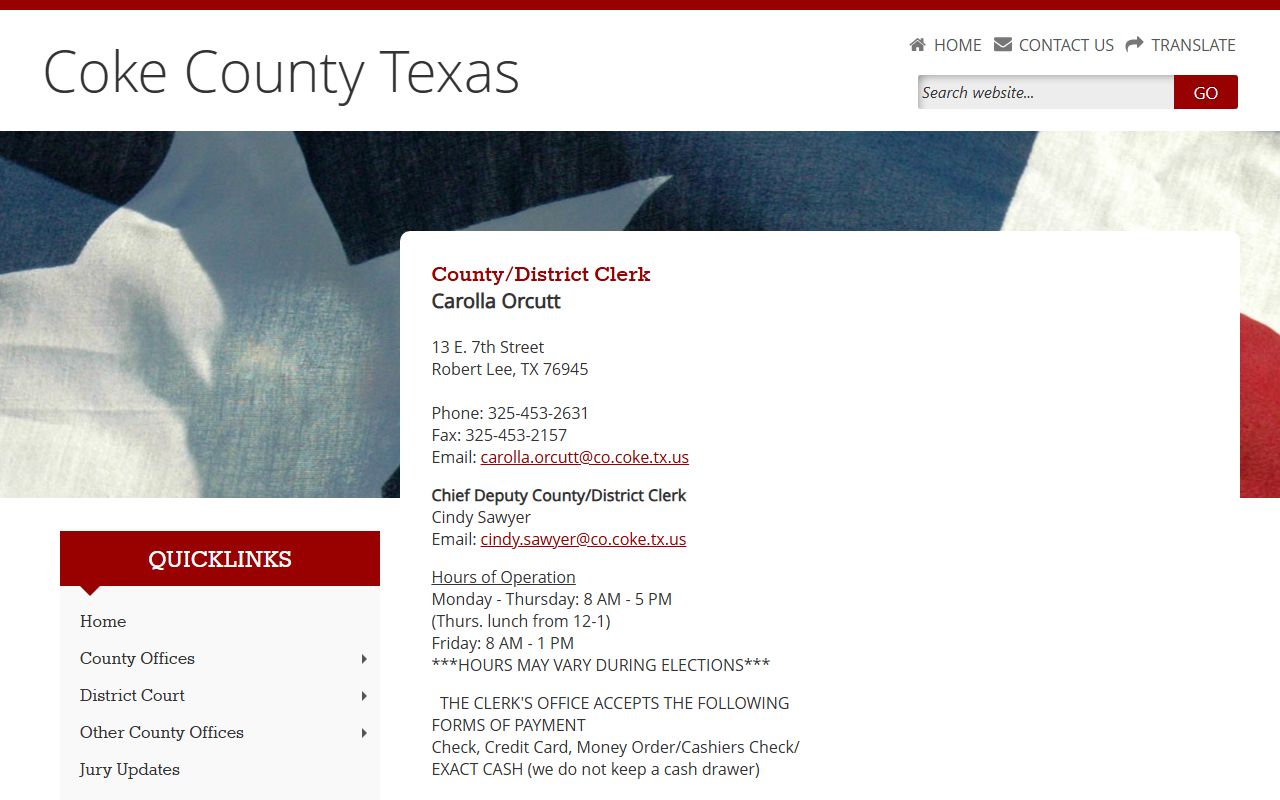
That clerk source connects the court-record search to the official Coke County office that maintains filed case and calendar information.
Coke County Arrest Court Calendar
The free iDocket court calendar for Coke County exposes search fields that help locate scheduled court events after an arrest. It is not a full warrant list and not the same as the complete judicial case-search account route. It is still useful when a person knows the case number, attorney information, or a likely date range.
| Field Label | Type | Required | Notes |
|---|---|---|---|
| Court | Dropdown | No | All Courts, district courts, county courts, County Court, and 51st District Court. |
| Search By | Radio/dropdown | No | None, Case Number, or Attorney. |
| From Date | Date | No | Start of calendar search range. |
| To Date | Date | No | End of calendar search range. |
| Bar Number | Text | Conditional | Used for attorney search. |
| Attorney Name | Text | Conditional | Last and first name fields are available. |
| Case Number | Text | Conditional | Used when the case number is known. |
The Coke County iDocket calendar screenshot shows these fields and court filters.
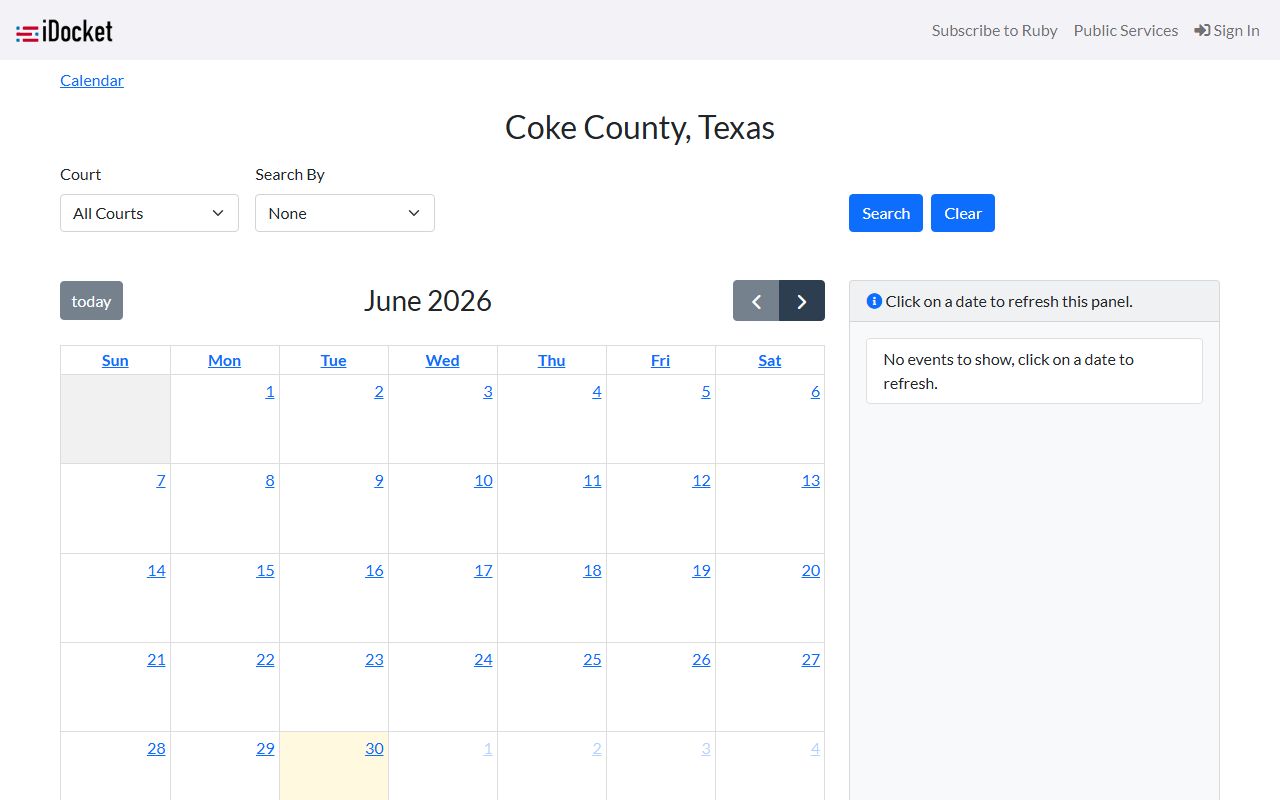
The calendar view is best for hearing dates and court filters, while full case details may require the clerk or iDocket sign-in route.
Coke County Judicial Case Search
The separate iDocket Judicial Case Search routes to a sign-in page with User Id and Password fields. The visible page also offers Forgot Password, Subscribe to iDocket, Contact Support, Available Counties, Subscription Plans, and Ruby FAQs. Its disclaimer says information is collected from courts, counties, and clerks, while iDocket is independent and not an agent of any court, county, clerk, or other entity. For the most current record, contact the Coke County clerk directly.
- Confirm custody or release status first if the arrest is recent.
- Search the iDocket court calendar by court, date range, case number, or attorney.
- Use the judicial case-search sign-in route if subscribed access is needed for more detail.
- Contact the County/District Clerk for case number, copy, certification, or record-access questions.
- Compare the filed court charge with any booking charge because they may differ.
Coke County Arrest Charging Documents
After a Coke County arrest, the court record starts with a charging document or court filing. A complaint can state the accusation and support initial court action. An information is a prosecutor-filed charging document often used in non-grand-jury situations where allowed. An indictment is returned by a grand jury and is common for serious felony prosecution. The exact document depends on charge level, court, and prosecutor action.
| Document | Who Uses It | What It Means |
|---|---|---|
| Complaint | Officer or prosecutor | States alleged facts or an accusation used to start or support a case. |
| Information | Prosecutor | Formal prosecutor-filed charge where indictment is not the filing route. |
| Indictment | Grand jury | Formal felony accusation returned after grand jury review. |
Coke County Prosecutor Records
Coke County has both county-level and district-level prosecutor contacts. The District Attorney page lists Allison Palmer and phone 325-659-6584 for felony prosecution in the 51st District Court system. The County Attorney page lists Cody McCabe, 13 East 7th Street, Robert Lee, phone 325-400-5525, email cody.mccabe@co.coke.tx.us, with weekday hours published by that office. Prosecutors decide whether the arrest charge becomes a filed complaint, information, indictment, amended charge, dismissal, or other filing.
The prosecutor's decision is why a jail profile warning should be taken seriously. A receiving jail may show a booking charge and bond amount, but charges and bail can change after court appearances. Court records after a jail arrest show the filed charge and later disposition. The jail can confirm current custody and bond, while the clerk confirms filed case records.
Coke County Charge Status Records
Charge status changes as a case moves. Pending means the case has not reached final disposition. Amended or reduced means the filed charge changed from the earlier version. Dismissed means the court record reflects a charge no longer being pursued in that case. A conviction means a guilty plea, verdict, or other finding has been entered. None of those meanings can be assumed from the booking record alone.
| Status | What It Means | Where to Confirm |
|---|---|---|
| Pending | The charge is filed and unresolved. | Clerk case record or court calendar. |
| Amended | The charge wording, level, or count changed. | Filed court documents. |
| Reduced | The charge moved to a less serious offense. | Case docket and prosecutor filing. |
| Dismissed | The court record shows the charge was dismissed. | Final disposition or order. |
| Convicted | A plea, verdict, or judgment created a conviction. | Judgment and sentence record. |
Coke County Arrest Bond Court
Texas Code of Criminal Procedure Chapter 17 governs bail and bond decisions. In Coke County, bond information may start with the receiving jail after booking, but the court controls bond settings and conditions. Cash bond, surety bond, PR bond, no-bond status, and detainers should all be verified with the actual custody facility or court. A hold from another county, parole authority, federal agency, or ICE can prevent release even if a local bond is posted.
| Bond Issue | Record Source | Practical Check |
|---|---|---|
| Initial amount | Receiving jail or magistrate record | Call detention staff before paying. |
| Case number | Clerk or court record | Use case number for court calendar search. |
| Surety bond | Bonding company and court | Verify company and court before payment. |
| No-bond hold | Court or holding agency | Ask whether another detainer blocks release. |
Coke County Arrest Warrant Records
Coke County's official sheriff page does not publish an active-warrant list. Warrant checks should go through the sheriff's office, the issuing court, or the clerk. The county contact page lists the Justice of the Peace traffic-ticket contact at 224 West Main Street, Bronte, TX 76933, phone 325-473-2323. The County/District Clerk can help with filed case and court-calendar questions. A warrant can lead to a booking, but it is not the same record as a jail roster entry.
If a person may have an active warrant, contact the court or an attorney before appearing at a law-enforcement office. A warrant may be resolved by court appearance, bond, attorney filing, payment plan, recall or quash order, or arrest and booking, depending on the court and warrant type.
Coke County Charges vs Convictions
Arrest and charge records are accusations. A conviction is a court outcome. This distinction is essential for Coke County court records after a jail arrest because a person may be booked, have a charge filed, and later have that charge amended, dismissed, reduced, or resolved by plea or trial. A booking record should never be treated as proof of conviction.
| Charge | Conviction | |
|---|---|---|
| Stage | Accusation after arrest or filing. | Final or adjudicated court outcome. |
| Proof Level | Based on probable cause or prosecutor filing. | Based on plea, verdict, or judgment. |
| Where Found | Jail profile, complaint, information, or indictment. | Judgment, sentence, and disposition record. |
| Search Risk | May change quickly after first appearance. | Should still be verified with the clerk. |
Coke County Sealed Expunged Records
Texas Code of Criminal Procedure Chapter 55 is the expunction chapter. Coke County clerk pages also link nondisclosure resources. Expunction and nondisclosure are different remedies. Expunction can remove or destroy qualifying arrest records from public access. Nondisclosure limits public access to qualifying records but may still allow certain agencies to see them. Eligibility depends on the charge, outcome, timing, and court order.
| Nondisclosure / Sealed | Expunged | |
|---|---|---|
| Public Visibility | Restricted from many public searches. | Removed or treated as not existing where ordered. |
| Agency Access | Certain agencies may retain access. | Very limited access after order. |
| Common Trigger | Qualifying disposition under Texas law. | Qualifying dismissal, acquittal, or other eligible outcome. |
| Proof Needed | Court order. | Expunction order. |
Restricted Coke County Court Records
Not every record tied to an arrest is public in full. Juvenile matters, sealed records, expunged records, protected personal identifiers, confidential investigative details, body-camera material, and certain victim or medical information may be withheld or redacted. Texas Government Code Chapter 552 and the Attorney General ruling process govern many of those decisions. Coke County's sheriff form warns that confidential information may be withheld and that records can be redacted.
Important: A public lookup is not a consumer report and should not be used for employment, credit, housing, insurance, or tenant screening.